Title: Hearing
Foreign Title: Thính Giác
Year: 2026
Country: Vietnam, Singapore, Norway, France, Indonesia, Saudi Arabia,
Cambodia, Thailand, Taiwan, China
Language: Vietnamese with English Sub Titles
Director: Bao Le(I)
Cast: Click this Link for the Cast
Click this link for the awards
Knowing Bao Le’s previous work I would argue (and it is my own interpretation) that the narrative is merely the starting point for a long cinematic journey, one in which the plot and destination no longer matter.
As he explained during the Q&A, the film is based, among others, on his parents’ broken relationship. It follows a middle-aged engineer who installs decibel meters in public spaces. When the noise reaches a certain level, a purplish-blue light is emitted. He lives with his mother and massages her tired legs. He visits his father, who lives in the countryside and refuses to see his mother. His ex-wife and children live with her father, and she asks him not to visit them at school. He tends to the garden in a way that echoes his father. His body resembles his father, arousing his mother.
All these things, and more, happen, but they are not really what the film is about. They might constitute a second, more personal layer for the director. They may prompt viewers to reflect on parenting and parent-child relationships, on how we resemble our parents and repeat their mistakes. But this is not the film’s essence.
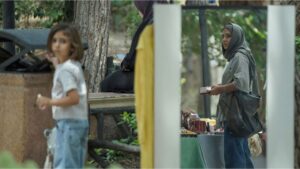
Once the film begins, we are transported into a dreamlike, meditative state of mind. The framing, compositions, and mise-en-scène are unique and powerful, like slowly moving paintings. It is a study in fifty shades of green. With every frame, Bao Le challenges our senses. Every sound, every spoken word, every movement of the camera or a character draws us deeper into an awakened, almost hypnotic state of consciousness.
This is slow cinema at its best.
A must-see film but be prepared