Title: BitterSweet
Foreign Title: Agridulce
Year: 2026
Country: USA/Dominican Republic
Language: In Spanish with English subtitles
Director: Frank Pavich
Cast: Click Here to See the Cast and Crew
“I would like to die,” a voice-over whispers. Eleven-ish Orianny sits chewing gum as her older sister brushes out a thick tangle of hair. It’s a shocking opening to a coming-of-age film — one that effortlessly delivers the first bittersweet bite that will mark this little feast of a documentary. (In our new age, where truth is at a premium, it’s a small but appreciable benefit to see it front and centre in a documentary, especially “out of the mouths of babes.”)
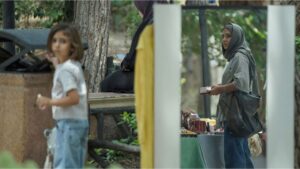
Orianny goes on to explain her choice of words, “Saying goodbye to my family. I have always imagined that when I die people will sing to me and not cry. Because everyone goes to the next place… To heaven.” She also speaks of life on the street. Of prostitution that she calls seducing gringos.
Set in the town of Cabarete in the Dominican Republic, the documentary follows four talented child musicians over five years of filming. They are the few children of the marginalized who have been promised hope and a “home” at the Academia de Bachata, a free school of music founded in 2013 to harness the uplifting power of ‘Bachata’ and offer stability to a beleaguered community through music and mentorship. Interestingly, it was the film’s visionary producer, Benjamin De Menil, who founded the school––making De Menil not only the creative force behind the documentary but also the architect of the very institution the documentary celebrates. It’s also the world’s only school to teach bachata music.
Beside Orianny, we are introduced to Yerian, Edickson, and Frandy—three boys whose distinct personalities compose the rest of the film’s musical quartet. (If only their childhoods were as innocent as the joy we witness when they’re tight and jamming under the roof of the Academia.)
What is the ‘bittersweet’ in bachata?
When our music was given the name ‘bachata’, it wasn’t a compliment. It was intended as an insult, as a humiliation…
The sweet has always been there in the music’s vibrant, infectious rhythm—a groove so welcoming that local tourism boards celebrate it as a “contagious smile where clumsy footwork is met with warmth rather than judgment.” The bitter, however, harkens back to the genre’s origins as música de amargue, or “music of bitterness,” playing with the raw lyrics of heartbreak, melancholy, and the stark poverty of the Dominican working class.
If the challenge is to balance the two, it makes Mártires de León, the renowned guitarist and teacher at the Academia, the “best supporting actor” under whose mentorship these four youths may discover how to navigate the precarious realities of their daily lives toward a bachata stardom, toward the “way out” through the narrow doors of the music industry. I found Yerian’s story particularly affective. His father, Jose Castillo, who calls himself a ‘bachatero’, a bachata artist, is a single father. I won’t deny it; I was unfaithful to his mother. He’s had his days of fame but he’s happy to share a tune with the camera: I don’t know what’s happening with Gisela
She keeps playing with my worm
She has a little device
It grabs my worm in its teeth
It’s now up to his son “so that he can make it as an artist”. They sing a song composed by Yerian while riding a horse together, one behind the other, as in life, so in song.
What pretty legs
What beautiful legs
if I could turn into Spider-Man
I would spend my time crawling up and down
The “raciness” or, as I prefer to see it, “rawness” of some bachata lyrics does present a challenging perspective to the well-intentioned and considerably successful initiative. De Menil did wrestle with “teaching” bachata: It’s a real delicate subject. At the same time, the music reflects subjects that are part of the culture. We want to be in a position where we’re supporting the culture in a positive way, and not trying to do something that is contrary, or sort of whitewashing it in some way.
Today the students of the Academia are to be on a TV show. Wear the best shirt you have. The one that’s least faded. On the show, Martinez holds the mic loosely; he’s familiar with this instrument. We’re like baseball academies who recruit future star players. We’re doing the same with future bachata stars. The school gathers to watch and enjoy their “stars” on the screen.
Edickson and Frandy are older. Frandy speaks of the heart. From the heart. My mother struggled with me. She’s taught me right from wrong. His mother tears up and leaves the room. Edickson’s mother is a single mom. Odianny’s mom is single too. I don’t let Orianny out of my sight. So she doesn’t escape from me. You get the picture.
It is to Frank Pavich’s credit that in this picture he has surrendered the narrative to the voices of (mostly) the four ‘kids’, with the knowledge that they are deep and express themselves in truly miraculous and beautiful ways.
The result is a work that affirms John Keats’ insight: truth is beauty. There is so much truth though in this documentary that we may miss the forest of growing up in DR for the four trees that stand taller at the end. As Edickson says, You’ve got to burn your eyelashes day and night. It’s not an easy road. You have to pay your dues. Imagine you’re playing on stage and everyone is chanting, Orianny! Orianny!
What would you do?