Title: Rebecca Horn – the Secret Life of Things
Foreign Title: Rebecca Horn – Die Seele der Dinge
Year: 2026
Country: German
Language: In German with English subtitles
Director: Claudia Müller
Click here to see the cast and crew
If you are open to – or even curious about – modern art but have never heard of the grand dame of German art, Rebecca Horn, this documentary is for you.
When considering how to set the stage for her subject, director Claudia Müller made an inspired editorial decision: if Rebecca Horn’s life’s work revolved around using motion to navigate the boundaries of the self – through performance, dance, kinetic sculpture, film and poetry, then the best introduction should begin with the title sequence itself. As random letters float and circle behind the title The Secret Life of Things, they come to a sudden stop – mimicking the contracting motion of her 1982 kinetic sculpture, The Peacock Machine – before they cascade and coalesce into the capital letters of her name.
It is the strangeness of her kinetic sculptures that first strikes us – in a way that would have pleased the turn-of-the-century Formalists who argued for a “difficult and defamiliarized” art in all its forms. Rebecca Horn’s performances and kinetic sculptures lend themselves naturally to a Formalist discourse, offering a consistent challenge to aesthetic norms, regardless of medium.
At 20, she would not have asked for it, but the tragedy that derailed Horn’s youth was undeniably fortuitous. During her first year at Hamburg’s Academy of the Arts, Horn suffered an acute lung infection after inhaling fiberglass particles while sculpting without a protective mask, leading to a 12-month stay in a sanatorium. She had no contact with the outside world. Also, her parents died. Isolation, confinement, grief. As she later recalled: “I was totally isolated. That’s when I began to produce my first body-sculptures. I could sew and draw lying in bed.
Müller’s film examines every important work produced by the artist, a testament to her dedication to honoring her subject’s massive legacy.
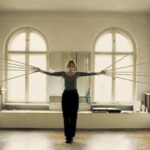
My highlights would begin with works that were issued from her isolation, when she began sketching and sewing wearable fabric and wood structures designed to defy human spatial limitations. We see this in the towering 3-foot white cone or horn, placed on the head of one of her subjects walking for hours through the woods and fields in Unicorn (1970) and later in a much larger 15-foot prosthetic version, Head Extension (1972). (Was it the ‘acting out’ of a realized Formalist difficulty worn as her namesake “horn”?) Related to these “Personal Art” performances, there was the iconic Finger Gloves (1972) in which balsa-wood extensions enabled her to reach and search along the sides of the room, like a low-tech precursor to Edward Scissorhands.
Of her many kinetic and mechanical sculptures, Concert for Anarchy (1990) particularly surprised me. Here, a grand piano is hoisted to hang upside down from a museum ceiling. Without warning, the keyboard casing opens and the inner keys, like a hundred tongues, burst out before returning to their “normal” state. The sight of the piano hanging upside down is itself a brilliant “violation of the norm.” Like her other mechanical pieces, space is not just a container; space is context.
Scale in art is humbling, whether in macro or micro. Two parallel works, Tower of the Nameless (1994) and Inferno (1993), are multi-story structures. The former is dedicated to the nameless refugees fleeing the Balkan wars: in one of its iterations, seventeen ladders branch out from a single ladder touching the floor, rigged with nine automated violins moved to play a monotonous lament. The latter consists of eleven antique hospital beds chaotically stacked as high as fifty feet, where electricity flashes and sparks from glass tubes installed in the structure. The human body completely disappears in these late works, its pain merely a memory invoked by the mechanical sounds they emit.
Of her contemporaries, it is Marina Abramović who lends her voice to the film, explaining the relevance of her foundational 1975 performance piece, Art Must Be Beautiful, Artist Must Be Beautiful:
brushing the hair with an iron brush,
destroying the hair, destroying the face,
creating this image that art is NOT about beauty,
art is about being disturbed, art is about asking questions.
I get it. Otherwise, what is art for?