
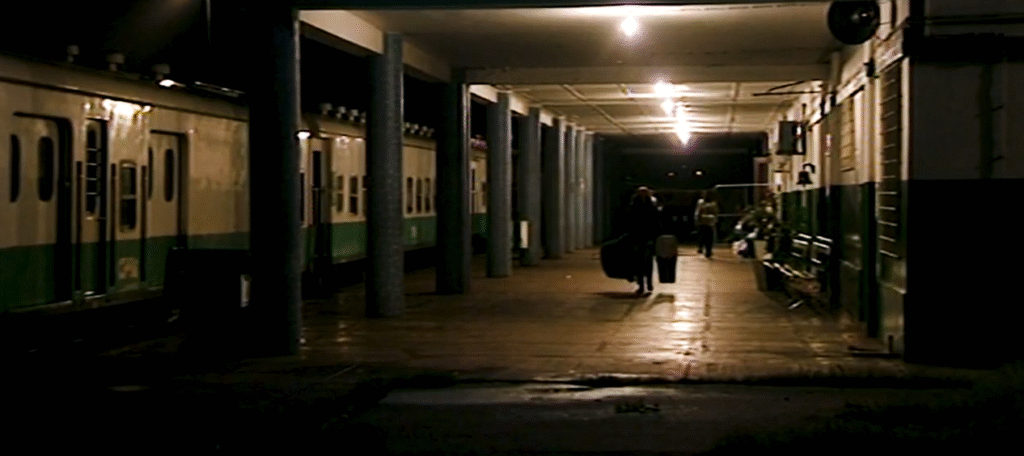
Title: Night Train
Year: 2024
Country: South Africa
Language: Zulu with English Subtitles
Director: Kevin Harris
Cast: Rudi Keyser(editor)
A documentary that brings to light the dark side of the “iron road” – the railway line built by President Paul Kruger from Johannesburg to Lorenzo Marques in 1894 – and the “night trains” that ferried some 5 million Mozambican migrant workers between 1901 & the 1960s to work the coal & gold fields of the Witwatersrand that built the prosperous industrial economy of South Africa.
Integral to the soundtrack is the composition “Stimela” – composed & performed by the late great South African musician Hugh Masekela – evocatively capturing the enduring memory and trauma of journeys on steam-trains such as the “Night Train” – that chiseled their way into the souls of black men and women across Southern Africa.
“Between the 1900s & 1970s some 5 million Mozambican migrant workers rode the “night train” to come & work the coal & gold mines of the Witwatersrand that built the booming industrial economy of South Africa.
Review:
This documentary is inspired by the academic research of Professor Charles van Onselen on his non-fiction novel “The Night Trains” published in 2020. I n 2021 He was awarded the 2021 ASSAf Humanities Book Award for his publication
As a fan of Hugh Masekela, I often listened to the soundtrack Stimela (Coal Train) which plays throughout the documentary with its background of the trains coming from Lorenzo Marques (today known as Maputo) The song has remained with me for a very long time (1968 I believe) with Hugh’s rasping voice and foreboding words narrating the plight of the black workers conscripted from surrounding areas, such as Mozambique and Zambia to work in the gold and coal mines in Johannesburg and Witbank. The composition is incredible beginning with the sounds of the miners striking the rocks in the mines, the percussion sounds of the steam train wheels on the tracks and the train whistle sounds.
The film packs a lot of detail into its 55 minutes, effectively with narration by Gabrielle Devine and interviews including 2 retired miners from Mozambique , Alfred Wachane and Fernando Nyabola, Barbara Masekela (Hugh’s younger sister living in Witbank) There was also David Marks , a composer and musician who is interviewed about his time in the mines and wrote some of the underground songs from his experiences with the miners. The narration and the interviews are spread evenly throughout the film to make it interesting and informative
The railroad was designed by Portuguese Engineers, with some tricky construction in South Africa across a major bridge span of some of the terrain over a waterfall, which required a restriction of speed on that portion. An accident took place quite a few years later where 60 or so miners returning to Mozambique, lost their lives when the Engine and some carriages plunged into the river below on their way back home.
The journey took about 16 hours to Johannesburg, always leaving at night.
Most of the miners were happy to go and work as they could earn good money: there were no jobs in their own countries. They would not see their families for at least a year and would come back with presents and gifts for their families, especially at Xmas when they got bonuses. A portion of their wages were sent to their families periodically.
Conditions in the mine were not ideal and many never survived, because of Tuberculosis and other diseases. The journey back home was always crowded and if they were suffering from any disease, there would be a chance of death before arrival back in Mozambique.
While it is a sad fact about the miners and the conditions, it is a powerful documentary about that part of history. It is well-made and. I would recommend trying to see it.
I believe it can now be watched on YouTube